
3D printing materials compared
Whether a printed part survives in use depends more on the plastic than on the printer. These are the six FDM materials we work with and what each one is good for.
- Process
- FDM
- Standard range
- PETG, PLA
- On request
- ABS, ASA, TPU, nylon, carbon fibre
- Material choice
- recommended with the quote
Which plastics suit FDM printing
In FDM the nozzle melts a plastic wire, the filament, and lays it down line by line and layer by layer. Only thermoplastics work this way: plastics that soften when heated and set again as they cool. Silicone, thermosets and metals cannot be printed like this.
Every FDM part has one trait in common. It is noticeably stronger along the printed lines than across the layers. We therefore choose the print orientation so that the main load runs along the lines rather than pulling the layers apart.
Material comparison
| Material | Strength | Service temperature | UV resistance | Flexibility | Availability |
|---|---|---|---|---|---|
| PETG | high, impact resistant | up to approx. 75–80 °C | limited | slightly flexible | standard |
| PLA | stiff but brittle | up to approx. 55–60 °C | no | stiff | standard |
| ABS | high, impact resistant | up to approx. 95 °C | poor | stiff | on request |
| ASA | high, impact resistant | up to approx. 95 °C | yes | stiff | on request |
| TPU | abrasion resistant | up to approx. 70 °C | moderate | rubber-like | on request |
| Nylon (PA) | very high, wear resistant | approx. 80–100 °C | moderate | tough | on request |
Guide values. They depend on the filament maker, the infill and the load on the part, so we confirm critical requirements in the quote.
PETG and PLA: the standard range
PETG is the plastic most of our batches are printed in. It is tough rather than brittle, absorbs almost no water and copes with many cleaning agents and oils. Enclosures, brackets, covers and clips in PETG stand up well to daily use in a workshop or on a machine.
PLA is stiffer and prints very accurately, but it softens from about 55 °C. A part on a car dashboard in summer or next to a motor is no place for PLA. For display models, design samples and gauges with no heat load it is the right choice.
ABS and ASA: when things get warm
Both plastics hold up to about 95 °C and suit parts inside vehicles, on light fittings or in control cabinets. ASA is also UV resistant: it does not yellow or turn brittle in the sun, so anything mounted outdoors for good is printed in ASA.
ABS and ASA shrink more than PETG as they cool. In an open printer larger parts warp and lift at the corners, so we print them only with an actively heated chamber that keeps the air around the part evenly warm.
TPU: flexible, rubber-like parts
TPU is a thermoplastic elastomer. It bends, compresses and stretches, then returns to its shape. We print seals, bumpers, cable grommets, grips and protective caps from it. At about 95A on the Shore scale it feels like hard rubber but keeps its form.
Printed TPU is only partly suited to seals under pressure, because fine channels can remain between the layers. The quickest way to find out whether a printed seal is enough for your case is a test sample.
Nylon and carbon fibre: for friction and heavy loads
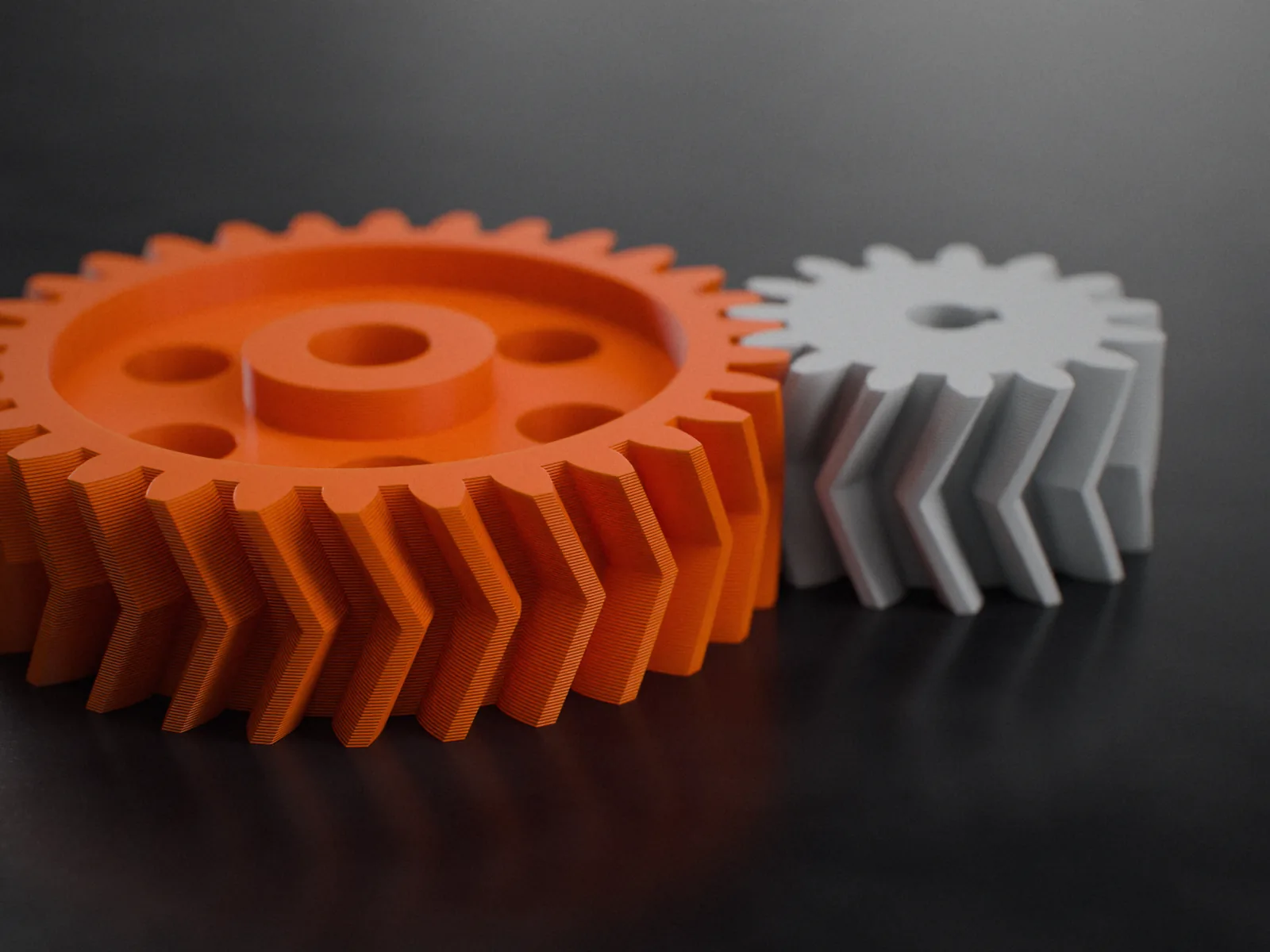
Nylon (polyamide, PA) is tough and wear resistant. Gears, bushings, hinges and snap hooks in nylon survive many load cycles in which PLA would crack and PETG would wear. Nylon does take up moisture from the air, so we dry the filament before printing.
With short carbon fibres, as PA-CF or PETG-CF, parts become stiffer and more dimensionally stable, with an even matt surface. They replace aluminium brackets and levers where weight matters. Fibre-filled filaments wear out ordinary nozzles, so we print them only with hardened steel nozzles.
Choose a material in three questions
- How warm does it get where the part works? Up to 60 °C any plastic will do, up to 80 °C PETG, up to 95 °C ABS or ASA.
- Is the part mounted outdoors? Then ASA, because the others lose colour and toughness in the sun over time.
- Does it need to flex, slide or damp vibration? TPU for flexibility, nylon for friction. In every other case, start with PETG.
Colours
Black, white and grey as standard, plus a few basic colours. The calculator shows which colours are currently available in the chosen material. A special colour for a batch can be sourced on request.
Common questions
Which material do you use if I am not sure?
PETG. It is strong, copes with moisture and holds its dimensions across large quantities. Tell us where the part will be used and we will check the choice in the quote.
Do you also print with SLA, SLS or metal?
No. We work only with FDM, because it is the process best suited to producing plastic parts in batches economically.
How large can a part be?
Up to 256 × 256 × 260 mm in one piece, which is the build volume of our Bambu Lab X2D printers. Larger parts are split into segments that are glued, screwed or clipped together after printing.
Why are some materials available only on request?
ABS, ASA, TPU and nylon need different settings and more preparation. An engineer confirms the price after checking the model.
A file or just an idea? Either is enough to start.
Upload a model and see a guide price straight away, or tell us what you need. Written enquiries get a specific quote in reply.